General information, not medical advice. Sea moss contains iodine. Ask your GP before use if you have a thyroid condition, take medication, or are pregnant or breastfeeding. Quality & Testing.
## Introduction: The prebiotic gap in your probiotic routine
If you already take a daily probiotic or eat fermented foods, you have addressed one half of the microbial equation: introducing beneficial bacteria. The other half, selectively feeding the beneficial taxa already resident in your colon, requires prebiotic substrates that reach the large intestine intact.
This distinction matters because most common prebiotics (inulin, fructo-oligosaccharides, galacto-oligosaccharides) target a relatively narrow set of Bifidobacterium and Lactobacillus species. The sulphated galactans in *Chondrus crispus*, the true Irish moss, represent a structurally distinct class of prebiotic substrate. These complex, sulphated polysaccharides resist hydrolysis by human digestive enzymes and arrive in the colon where they serve as selective carbon sources for specific microbial communities (Sonnenburg & Backhed, 2016).
The central question for anyone already investing in gut health is straightforward: what does sea moss add that a probiotic capsule cannot provide? The answer lies in the specific taxa affected, the metabolite cascade they produce, and the downstream consequences for barrier integrity and metabolic signalling. However, the evidence base is more complex, and more honestly limited, than most wellness marketing acknowledges.
## How sulphated galactans survive the upper GI tract
### The structural basis of resistance
Carrageenans constitute approximately 50 to 65 percent of the dry weight of *Chondrus crispus*. These are linear, sulphated galactans built from repeating D-galactose units linked by alternating alpha-1,3 and beta-1,4 glycosidic bonds, with varying degrees of sulphate ester substitution. The human genome does not encode carbohydrate-active enzymes capable of cleaving these specific linkages (Cherry et al., 2019).
This enzymatic gap means that when you consume sea moss gel, the carrageenan matrix transits through the stomach and small intestine largely intact. Unlike simple sugars or even starch, these polysaccharides are not absorbed in the upper GI tract. Instead, they reach the colon where the resident microbiota, equipped with specialised glycoside hydrolases, can ferment them (Lopez-Santamarina et al., 2020).
### Sulphation patterns determine bacterial access
Not all carrageenan is equivalent. The three major types differ in their degree of sulphation:
| Carrageenan type | Sulphate groups per disaccharide | Primary seaweed source | Key structural feature |
| --- | --- | --- | --- |
| Kappa (kappa) | 1 | *Kappaphycus alvarezii*, *Chondrus crispus* | Forms rigid, brittle gels |
| Iota (iota) | 2 | *Eucheuma denticulatum* | Forms soft, elastic gels |
| Lambda (lambda) | 3 | *Chondrus crispus* (gametophyte) | Non-gelling, viscous |
This structural variation matters because different bacterial species possess different enzymatic toolkits. The sulphation pattern determines which taxa can access the galactan backbone as a carbon source, which is why species identification (*Chondrus crispus* versus *Gracilaria* versus *Eucheuma*) directly affects the prebiotic profile of any sea moss product (Cherry et al., 2019).
> "Oligosaccharides enzymatically hydrolyzed from alginate, agarose, and carrageenan have shown prebiotic activities, stimulating Bifidobacteria and Lactobacilli growth and producing SCFA."
> Cherry et al. (2019). *Prebiotics from Seaweeds: An Ocean of Opportunity?*
For a deeper exploration of species differences and why labelling accuracy matters, see [The Species Identity Crisis: Not All Sea Moss Is Created Equal](/blogs/learn/benefits/sea-moss-minerals-explained).
## Bifidobacterium breve: The primary responder
### What the rat data shows
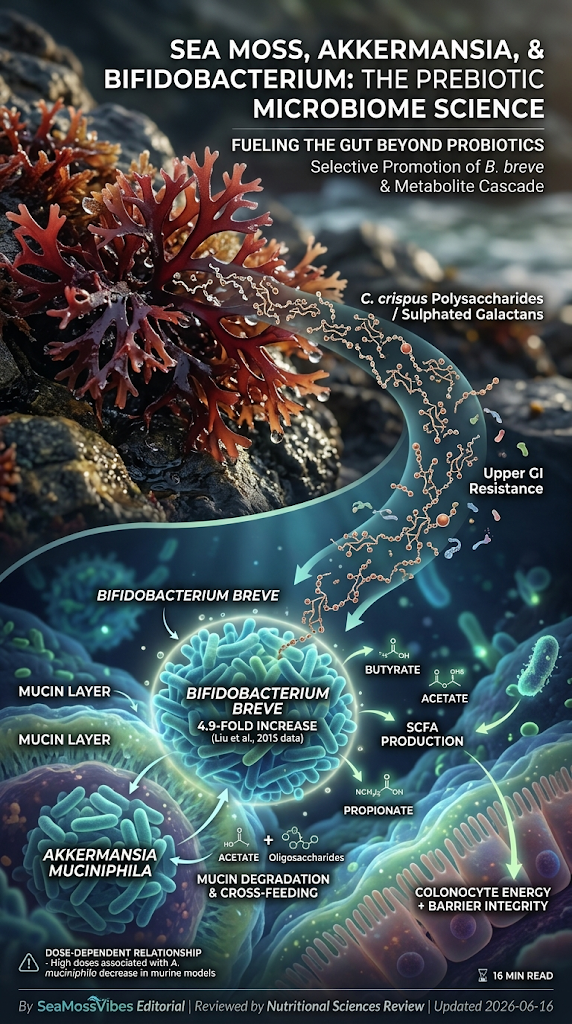
The most direct evidence for *Chondrus crispus* as a prebiotic substrate comes from Liu et al. (2015), who supplemented weaning Sprague-Dawley rats with 2.5 percent *C. crispus* (dry weight/weight) for 21 days. The results were specific and measurable:
- **Bifidobacterium breve** increased 4.9-fold compared to control (p = 0.001)
- **Clostridium septicum** and **Streptococcus pneumoniae** populations decreased
- Faecal short-chain fatty acids increased: acetate by 1.4-fold, propionate by 1.3-fold, and **butyrate by 2.1-fold**
These are not trivial shifts. A 4.9-fold increase in a single beneficial species, combined with pathogen suppression and elevated SCFA production, indicates genuine prebiotic selectivity: the polysaccharides are not simply bulk fibre fermenting indiscriminately.
### The SCFA metabolite cascade
The short-chain fatty acids produced during this fermentation are not merely waste products. Each serves distinct physiological roles:
```
[ Sulphated galactans from C. crispus ]
|
v
[ Colonic fermentation by B. breve and other taxa ]
|
+--------+--------+
| | |
v v v
Acetate Propionate Butyrate
| | |
v v v
Cross- Hepatic Colonocyte
feeding gluco- energy +
partner neo- barrier
bacteria genesis integrity
```
- **Butyrate** serves as the primary energy source for colonic epithelial cells and reinforces tight-junction integrity
- **Acetate** enters systemic circulation and serves as a cross-feeding substrate for other beneficial taxa
- **Propionate** is largely metabolised by the liver and influences hepatic gluconeogenesis
This metabolite cascade is what distinguishes a prebiotic intervention from simply adding more bacteria via a probiotic capsule. You are not introducing foreign organisms; you are shifting the metabolic output of the community already present (Sonnenburg & Backhed, 2016).
### Evidence quality disclosure
The Liu et al. (2015) study was conducted in weaning rats, not adult humans. Rodent microbiomes differ from human microbiomes in composition, transit time, and pH. While the directional findings (Bifidobacterium enrichment and SCFA elevation) are consistent with in vitro fermentation data from other seaweed polysaccharide studies, direct human clinical trials measuring microbiome composition shifts after *Chondrus crispus* consumption have not yet been published. This is a critical gap in the evidence base.
## Akkermansia muciniphila: The mucin-layer context
### Why Akkermansia matters
*Akkermansia muciniphila* is a mucin-degrading specialist that colonises the intestinal mucus layer. It constitutes 1 to 5 percent of the gut microbiota in healthy adults and has attracted significant research attention because of consistent inverse correlations with metabolic dysfunction.
In a study of overweight and obese adults, Dao et al. (2016) found that higher baseline *A. muciniphila* abundance was associated with:
- Lower fasting plasma glucose
- Lower waist-to-hip ratio
- Smaller subcutaneous adipocyte diameter
- Greater improvement in insulin sensitivity markers after caloric restriction
Depommier et al. (2019) extended this work with a randomised, double-blind, placebo-controlled trial in 32 overweight and obese volunteers. Pasteurised *A. muciniphila* supplementation over three months improved insulin sensitivity, reduced insulinemia by 28 percent, and decreased total cholesterol, though body weight reductions showed trends (minus 2.27 kg) without reaching statistical significance (p = 0.09).
### The cross-feeding mechanism
What makes *A. muciniphila* especially relevant to gut ecology is its role as a metabolic hub. When it degrades mucin glycoproteins, it liberates oligosaccharides and produces acetate and propionate. These metabolites become available to neighbouring butyrate-producing Firmicutes.
Belzer et al. (2017) demonstrated this directly through co-culture experiments. When *A. muciniphila* was grown alongside *Faecalibacterium prausnitzii*, *Anaerostipes caccae*, and *Eubacterium hallii*, the result was syntrophic growth and diet-independent butyrate production. The interaction with *E. hallii* was truly mutualistic. *E. hallii* provided pseudovitamin B12, which stimulated *A. muciniphila* to generate propionate in return.
| Cross-feeding partner | Metabolite received from A. muciniphila | Metabolite returned | Outcome |
| --- | --- | --- | --- |
| *Faecalibacterium prausnitzii* | Acetate, oligosaccharides | Butyrate | Trophic chain |
| *Anaerostipes caccae* | Acetate, oligosaccharides | Butyrate | Trophic chain |
| *Eubacterium hallii* | Propionate substrate | Pseudovitamin B12 | Mutualistic symbiosis |
### The carrageenan-Akkermansia paradox
Here, the evidence demands honesty rather than optimism. While the spec for this article originally framed kappa-carrageenan as selectively increasing *Akkermansia muciniphila*, the published literature presents a more complicated picture.
Shang et al. (2017) found that oral administration of carrageenan in C57BL/6J mice **decreased** *Akkermansia muciniphila* populations while inducing colitis-associated changes in gut microbiota composition. All three carrageenan types (kappa, iota, and lambda) significantly reduced this anti-inflammatory bacterium.
Conversely, the Liu et al. (2015) study using whole *Chondrus crispus* (not isolated carrageenan) showed beneficial prebiotic effects including Bifidobacterium enrichment and SCFA elevation, though it did not specifically measure Akkermansia abundance.
This discrepancy likely reflects several variables:
- [ ] **Dose matters.** Isolated, high-dose carrageenan in drinking water differs from whole-food sea moss containing carrageenan within its native polysaccharide matrix
- [ ] **Molecular weight matters.** Native, high-molecular-weight carrageenan (greater than 200 kDa) behaves differently from lower-molecular-weight fractions
- [ ] **Matrix effects matters.** Whole *C. crispus* contains co-occurring polyphenols, minerals, and other polysaccharides that may modulate the microbiome response
- [ ] **Species context matters.** Murine microbiomes are not human microbiomes; transit times, pH profiles, and baseline community composition all differ
The honest summary: whole *Chondrus crispus* shows prebiotic potential for Bifidobacterium and SCFA production in animal models, but the specific relationship between carrageenan and Akkermansia remains unresolved and should not be presented as established fact.
## What a 2 g daily serve actually delivers
### Estimating the prebiotic dose
A commonly recommended daily serve of dried *Chondrus crispus* is approximately 2 g (roughly half to one tablespoon of prepared gel). Based on the established carrageenan content of 50 to 65 percent of dry weight, this translates to:
| Component | Amount per 2 g dried C. crispus |
| --- | --- |
| Total carrageenan polysaccharides | 1.0 to 1.3 g |
| Sulphated galactan fraction | 0.8 to 1.1 g |
| Residual minerals, protein, lipid | 0.7 to 1.0 g |
In vitro fermentation kinetics suggest that sulphated galactans at this concentration are sufficient to reach the colon intact and serve as a fermentation substrate, producing measurable increases in SCFA output within 24 to 48 hours of incubation with human faecal inocula (Cherry et al., 2019).
However, translating in vitro fermentation rates to in vivo colonic conditions requires caution. Colonic transit time, pH gradients, existing microbiome composition, and dietary context all influence whether a given dose produces meaningful microbial shifts in a living human.
### How this compares to established prebiotics
For context, the clinically validated prebiotic dose for inulin-type fructans is typically 5 to 10 g per day. A 2 g serve of dried sea moss delivers roughly one-fifth to one-quarter of that total fibre load, but as a structurally distinct substrate that targets different bacterial taxa. This is not a replacement for established prebiotics; it is a complementary substrate that expands the diversity of fermentable carbohydrates reaching the colon.
## Self-assessment: Is sea moss prebiotic support relevant for you?
Before adding sea moss for its prebiotic properties, work through this decision checklist with your practitioner:
### Prebiotic suitability checklist
- [ ] I do not have diagnosed SIBO (small intestinal bacterial overgrowth): *premature fermentation in the small intestine can cause painful distension within 30 to 90 minutes*
- [ ] My thyroid function is within normal range, or my practitioner has cleared me for iodine-containing foods: *sea moss iodine content can exceed the NHMRC upper limit of 1,100 mcg/day*
- [ ] I am not currently taking anticoagulants, metformin, ACE inhibitors, or stimulant laxatives: *sea moss can interact with these medications*
- [ ] I do not have a known allergy to red algae, carrageenan, or iodine
- [ ] I am sourcing batch-tested *Chondrus crispus* with published COA, not unverified *Gracilaria* or *Eucheuma* sold as "sea moss"
- [ ] I understand that human clinical evidence for sea-moss-specific microbiome effects remains limited, and I am not relying on this as a primary intervention for a diagnosed condition
If you checked all six boxes, sea moss may serve as a useful prebiotic adjunct to your existing gut-health protocol. If any box is unchecked, consult your healthcare practitioner before proceeding.
For a detailed exploration of SIBO risk and the bloating paradox, see [Sea Moss and the Gut: Prebiotic Efficacy vs. the Bloating Paradox](/blogs/learn/benefits/sea-moss-gut-health).
## The regulatory and safety framework
### Australian context: FSANZ and health claims
In Australia and New Zealand, health claims about food, including prebiotic claims, are regulated under FSANZ Standard 1.2.7 (Nutrition, Health and Related Claims). Under this framework, dietary fibre claims require a minimum of 2 g per serving, and any health claim must be either pre-approved or self-substantiated through systematic review and notification to FSANZ (FSANZ, 2016).
Sea moss is not currently classified as a prebiotic by FSANZ, EFSA, or any major regulatory body. The prebiotic effects described in this article are based on preclinical research data, not regulatory endorsement. No TGA-listed therapeutic claims can be made for sea moss in Australia.
**TGA disclaimer:** This article is for educational purposes only. Sea moss is not a medicine and is not intended to diagnose, treat, cure, or prevent any disease. The Therapeutic Goods Administration (TGA) has not evaluated these claims.
### Iodine safety
Sea moss is a potent iodine bioaccumulator. The NHMRC tolerable upper intake level for iodine in adults is 1,100 mcg per day. Batch testing via ICP-MS is essential because iodine concentration varies significantly between harvests. At SeaMossVibes, every lot is quantified in mcg/g and published on the Certificate of Analysis. If you have thyroid conditions, are pregnant, or are taking thyroid medication, consult your endocrinologist or GP before consuming sea moss.
### Heavy-metal sourcing and arsenic speciation
As a marine bioaccumulator, *Chondrus crispus* concentrates elements from seawater, including arsenic, lead, cadmium, and mercury. Total arsenic figures can appear elevated (10 to 50 mg/kg), but consumer safety depends on speciation. The majority of arsenic in rhodophytes exists as relatively benign organic arsenosugars, not toxic inorganic arsenic. Our supply chain uses both ICP-MS for total element screening and HPLC-ICP-MS for arsenic speciation, with results published per lot.
### Species-honesty note
The commercial term "sea moss" encompasses multiple genera with distinct chemistry. *Chondrus crispus*, cold-water North Atlantic, produces kappa- and lambda-carrageenan. *Eucheuma cottonii*, tropical, produces primarily kappa-carrageenan. *Gracilaria* species produce agar, not carrageenan. The prebiotic data discussed in this article pertains specifically to *Chondrus crispus* and should not be generalised to other species sold under the "sea moss" label.
### Allergy disclosure
Individuals with known allergies to red algae, carrageenan, or iodine should avoid sea moss products. If you experience gastrointestinal distress, skin reactions, or respiratory symptoms after consumption, discontinue use and consult your healthcare provider.
## Conclusion: What prebiotic support sea moss can and cannot provide
The sulphated galactans in *Chondrus crispus* represent a genuinely distinct prebiotic substrate: structurally different from inulin, resistant starch, or fructo-oligosaccharides, and capable of reaching the colon intact to serve as selective fermentation fuel. In rat models, whole *C. crispus* supplementation produces measurable enrichment of *Bifidobacterium breve*, suppression of specific pathogens, and elevated SCFA concentrations including a 2.1-fold increase in butyrate (Liu et al., 2015).
The Akkermansia story is more nuanced. While *A. muciniphila* is a critical player in gut barrier integrity and metabolic health, with human RCT data supporting its relevance to insulin sensitivity (Depommier et al., 2019), the direct relationship between carrageenan consumption and Akkermansia abundance remains contested in the literature. Whole-food sea moss and isolated carrageenan appear to produce different effects, and the dose, molecular weight, and food matrix all influence outcomes.
What sea moss adds to an existing probiotic routine is not more bacteria; it is a unique fermentation substrate that expands the diversity of carbon sources reaching your colonic microbiota. Whether this translates to clinically meaningful microbiome shifts in humans awaits direct clinical trial data.
Three practical takeaways:
1. **Start conservatively.** Begin with 1 to 2 g of dried *C. crispus*, or 0.5 to 1 tablespoon of gel, daily and observe for 7 to 14 days before increasing
2. **Verify your source.** Confirm species (*Chondrus crispus*), request the COA with iodine quantification (mcg/g), and check for arsenic speciation via HPLC-ICP-MS
3. **Consult your practitioner** if you have thyroid conditions, cardiovascular disease, are pregnant, or take anticoagulants: iodine and mineral interactions are clinically relevant
## Next step
[Take the Gut-Health Assessment](/vitality/assessment) to see whether your current microbiome support protocol has gaps, and whether sea moss prebiotic support matches your specific health goals and risk profile.
## References
- Belzer, C., Chia, L. W., Aalvink, S., Chamlagain, B., Piironen, V., Knol, J., & de Vos, W. M. (2017). Microbial metabolic networks at the mucus layer lead to diet-independent butyrate and vitamin B12 production by intestinal symbionts. *mBio*, 8(5), e00770-17. https://doi.org/10.1128/mBio.00770-17
- Cherry, P., Yadav, S., Strain, C. R., Allsopp, P. J., McSorley, E. M., Ross, R. P., & Stanton, C. (2019). Prebiotics from seaweeds: An ocean of opportunity? *Marine Drugs*, 17(6), 327. https://doi.org/10.3390/md17060327
- Dao, M. C., Everard, A., Aron-Wisnewsky, J., Sokolovska, N., Prifti, E., Verger, E. O., Kayser, B. D., Levenez, F., Chilloux, J., Hoyles, L., Dumas, M.-E., Rizkalla, S. W., Dore, J., Cani, P. D., & Clement, K. (2016). Akkermansia muciniphila and improved metabolic health during a dietary intervention in obesity: Relationship with gut microbiome richness and ecology. *Gut*, 65(3), 426-436. https://doi.org/10.1136/gutjnl-2014-308778
- Depommier, C., Everard, A., Druart, C., Plovier, H., Van Hul, M., Vieira-Silva, S., Falony, G., Raes, J., Maiter, D., Delzenne, N. M., de Barsy, M., Loumaye, A., Hermans, M. P., Thissen, J.-P., de Vos, W. M., & Cani, P. D. (2019). Supplementation with Akkermansia muciniphila in overweight and obese human volunteers: A proof-of-concept exploratory study. *Nature Medicine*, 25, 1096-1103. https://doi.org/10.1038/s41591-019-0495-2
- FSANZ. (2016). Australia New Zealand Food Standards Code Standard 1.2.7 Nutrition, health and related claims. Federal Register of Legislation. https://www.legislation.gov.au/Details/F2016C00082
- Liu, J., Kandasamy, S., Zhang, J., Kirby, C. W., Karakach, T., Hafting, J., Critchley, A. T., Evans, F., & Prithiviraj, B. (2015). Prebiotic effects of diet supplemented with the cultivated red seaweed Chondrus crispus or with fructo-oligo-saccharide on host immunity, colonic microbiota and gut microbial metabolites. *BMC Complementary and Alternative Medicine*, 15, 279. https://doi.org/10.1186/s12906-015-0802-5
- Lopez-Santamarina, A., Miranda, J. M., Mondragon, A. del C., Lamas, A., Cardelle-Cobas, A., Franco, C. M., & Cepeda, A. (2020). Potential use of marine seaweeds as prebiotics: A review. *Molecules*, 25(4), 1004. https://doi.org/10.3390/molecules25041004
- Shang, Q., Sun, W., Shan, X., Jiang, H., Cai, C., Hao, J., Li, G., & Yu, G. (2017). Carrageenan-induced colitis is associated with decreased population of anti-inflammatory bacterium, Akkermansia muciniphila, in the gut microbiota of C57BL/6J mice. *Toxicology Letters*, 279, 87-95. https://doi.org/10.1016/j.toxlet.2017.07.904
- Sonnenburg, J. L., & Backhed, F. (2016). Diet-microbiota interactions as moderators of human metabolism. *Nature*, 535(7610), 56-64. https://doi.org/10.1038/nature18846
---
*This article was prepared by [SeaMossVibes](https://seamossvibes.com.au) Editorial and reviewed by Nutritional Sciences Review. It reflects published preclinical and clinical evidence as of June 2026 and should not be interpreted as medical advice.*
Ready to start?
Turn what you learned into a daily ritual
Explore formats and product details, then check the physical label before use.
Explore products →
Listed ingredients · Storage guidance
