
General information, not medical advice. Sea moss contains iodine. Ask your GP before use if you have a thyroid condition, take medication, or are pregnant or breastfeeding. Quality & Testing.
## Introduction
The wellness landscape is currently captivated by *Chondrus crispus*, the Atlantic red algae better known as Irish Sea Moss. Propelled by viral claims that it contains "92 of the 102 minerals the body needs," it has transitioned from a historical survival food to a modern cabinet staple. For many, the appeal lies in its promise to resolve chronic bloating and "seal" a leaky gut.
However, for a botanical so widely consumed, the clinical reality is far more nuanced than social media suggests. While sea moss is structurally unique and biologically active, its interaction with the human digestive system is complex. It can act as a powerful prebiotic architect, yet for many seekers of gut health, it becomes the very source of the distension they are trying to cure.
The central question remains: **Is this marine botanical a genuine restorative agent, or is the "bloating paradox" making your gut health worse?** To navigate this, we must look past the marketing constructs and into the biochemical pathways of the gastrointestinal tract.
## The microbiome architect: prebiotic efficacy
The primary functional components of *Chondrus crispus* are its sulfated polysaccharides, specifically carrageenans, which constitute **50% to 65%** of its total dry weight. These complex linear galactans are unique because the human genome does not encode the carbohydrate-active enzymes necessary to cleave their specific glycosidic and ester sulfate linkages. Consequently, these fibers resist hydrolytic degradation in the upper GI tract, reaching the colon entirely intact to serve as a selective fuel source for the microbiome.
Clinical observations and in vivo models have identified significant **bacterial reshaping** following sea moss intake:
- **Bifidobacterium breve:** Preclinical models show a profound 4.9-fold increase in this beneficial probiotic species
- **Akkermansia muciniphila:** Sea moss stimulates this critical mucin-degrading bacterium, which is essential for maintaining the integrity of the gut barrier and mucosal lining
- **Pathogen suppression:** It physically suppresses quorum sensing in pathogens like *Pseudomonas aeruginosa* and decreases populations of *Clostridium septicum*
This microbial shift is likely the true driver behind the systemic "energy lift" reported by users. In the ecosystem of the gut, dosage is a matter of equilibrium rather than excess; when these bacteria ferment sea moss fibers, they produce short-chain fatty acids (SCFAs) that fuel the body's systemic metabolic processes.
> Saccharolytic fermentation of *Chondrus crispus* fibers yields elevated concentrations of short-chain fatty acids (SCFAs), specifically acetic, propionic, and butyric acids. Butyrate serves as the primary energy source for colonic epithelial cells, regulating cellular differentiation and reinforcing the integrity of the colonic lining.
## The bloating paradox: soothing vs. distension
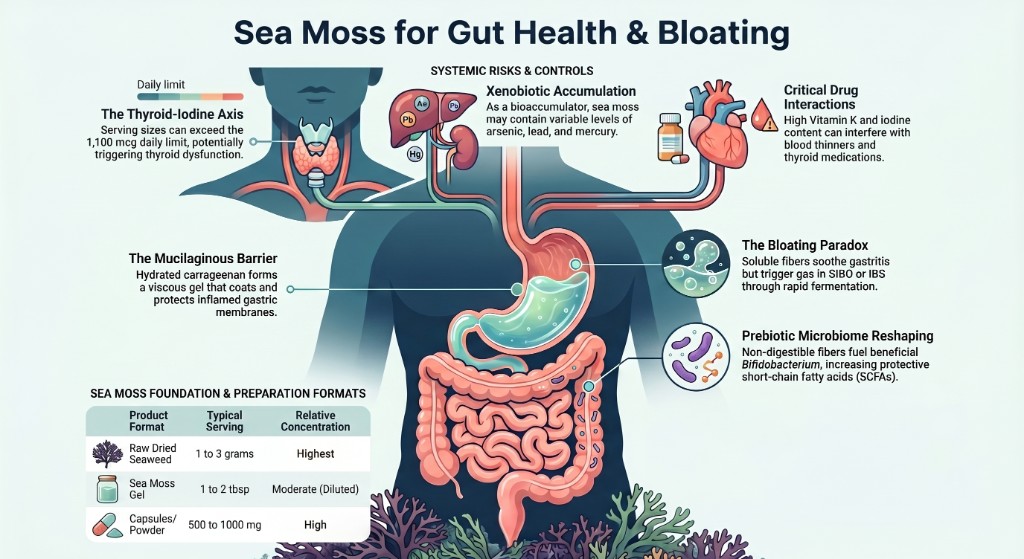
Sea moss presents a distinct clinical paradox. On one hand, it acts as a **demulcent** a mucilaginous substance that forms a protective, cohesive physical barrier to coat and soothe an inflamed gastric lining (gastritis). On the other, it can cause significant abdominal distension.
This paradox is often driven by **premature fermentation**. In a healthy gut, sea moss ferments in the colon. However, in patients with Small Intestinal Bacterial Overgrowth (SIBO), bacteria colonizing the small intestine ferment the polysaccharides too early. Because the small intestine is narrow and richly innervated with sensitive stretch receptors, this produces rapid, painful distension and upper abdominal flatulence within **30 to 90 minutes** of ingestion.
Furthermore, "more isn't better." Introducing high-fiber sea moss too quickly into a compromised system frequently overwhelms the patient's existing enzymatic and microbial capacity, leading to osmotic fluid shifts and acute gas production.
For a broader look at what is evidence-based versus marketing folklore in sea moss, see our companion guide: [Beyond the Hype: The Surprising Science and Pseudoscience of Sea Moss](/blogs/learn/benefits/sea-moss-science-pseudoscience).
Visual reference
Map your gut terrain before you dose
- Mucilaginous barrier vs. SIBO-driven distension
- Prebiotic reshaping and SCFA production
- Iodine, heavy metals, and drug interaction flags
## Debunking the "92 minerals" construct
The most pervasive marketing claim that sea moss contains 92 of the 102 minerals required by the body is an arbitrary marketing construct rather than a validated clinical metric. Human physiology only requires approximately **20 essential dietary trace minerals**. While sea moss is nutrient-dense, its composition is highly variable, dictated by environmental water quality and harvesting season.
The following table provides a nutritional reality check based on the actual daily value (DV) percentages found in a standard raw serving.
### Nutritional reality check
| Nutrient component | Concentration (per 20 g raw serving) | % Daily Value (DV) |
| --- | --- | --- |
| Iron | | 10% |
| Magnesium | | 7% |
| Zinc | | 4% |
| Folate | Negligible | Less than 1% |
| Copper | | 3% |
| Calcium | | 1% |
For a deeper breakdown of mineral counts, species differences, and lab-verified nutrient profiles, see [What Minerals Does Sea Moss Actually Contain?](/blogs/learn/benefits/sea-moss-minerals-explained).
## The iodine tightrope and thyroid health
The most significant systemic risk of sea moss is its **highly unpredictable iodine content**. While iodine is the essential substrate for thyroid hormones (T3 and T4), sea moss is a powerful bioaccumulator that can easily exceed the tolerable upper limit of **1,100 mcg per day**. This creates a bidirectional risk:
- **The Wolff-Chaikoff effect:** Sudden, excessive iodine can cause the thyroid to shut down, leading to iodine-induced hypothyroidism
- **The Jod-Basedow effect:** In patients with underlying Graves' disease or autonomous nodules, excess iodine can trigger uncontrolled hormone synthesis, resulting in iodine-induced hyperthyroidism
This endocrine disruption directly impacts the gut. Thyroid hormones regulate the **Migrating Motor Complex (MMC)** the "inter-digestive housekeeper" or "cleansing wave" of the gut. When the MMC is suppressed (as in hypothyroidism), the result is chronic constipation and fecal stasis, fueling the secondary fermentation that leads to persistent bloating.
See also: [Sea Moss, Iodine & Natural Energy: Why This "Electric" Superfood Is More Than Just Hype](/blogs/learn/benefits/sea-moss-energy-thyroid).
## The carrageenan controversy: safe vs. toxic
There is significant confusion regarding the food-grade carrageenan found in sea moss versus the toxic poligeenan (degraded carrageenan).
- **Food-grade:** High-molecular-weight polymers (exceeding 200,000 Da) that are generally recognized as safe (GRAS)
- **Poligeenan:** A low-molecular-weight polymer produced in labs using extreme acid hydrolysis, known to trigger mucosal barrier degradation and "leaky gut" states
The common myth that stomach acid converts sea moss carrageenan into toxic poligeenan is **clinically unsupported**; human gastric acid is too weak and the transit time too short for this chemical conversion. However, sourcing remains critical, as wild-harvested moss may contain variable fractions of degraded carrageenans due to natural environmental decay and stress before harvest.
## Critical drug interactions to watch
Sea moss is a biologically active intervention that can interfere with several medicinal regimens:
- **Metformin:** The viscous gel can physically coat the mucosal lining, potentially delaying gastric emptying and reducing the absorption kinetics of this diabetes medication
- **Anticoagulants (Warfarin):** Sea moss contains Vitamin K, which acts as an antagonist to blood thinners, predisposing patients to clotting events
- **Antihypertensives:** Due to high potassium levels, using sea moss alongside potassium-sparing diuretics or ACE inhibitors can lead to dangerous hyperkalemia
- **Cascara Sagrada:** There is a "physiological conflict" when taking sea moss with stimulant laxatives like Cascara. While the anthraquinones in Cascara stimulate peristalsis, the bulking carrageenans can lead to severe cramping and gastric reflux if the gut signals become conflicted
**Always disclose sea moss use to your prescriber** if you take any of the above medications.
## Practical protocol: the cold-hydration preparation
To minimize pathogen risk and optimize the texture of the gel, use the following standardized method.
**Starting dosage:** Begin with a conservative **1 3 g** of dried sea moss or **0.5 1 tablespoon** of gel daily to allow the gut microbiota to acclimate.
### The cold-hydration method
1. **Mechanical rinsing:** Wash raw dried moss under cold water, massaging for 3 5 minutes to remove salt, sand, and environmental debris
2. **Hydration and deodorization:** Submerge in filtered water for 12 24 hours. Add fresh lime juice to the soak to neutralize the "ocean aroma"
3. **Mechanical blending:** Drain and blend the rehydrated moss with 1.5 to 2 cups of fresh spring water until completely smooth
4. **Storage:** Store in an airtight glass jar and refrigerate. Discard strictly after 3 5 days
For gel dosing specifics, see our [Gel Dosage Guide](/blogs/learn/how-to-use/gel-dosage-guide).
### Sourcing checklist
- [ ] **Third-party testing:** Certified by USP or NSF
- [ ] **Species identification:** Confirmed *Chondrus crispus*
- [ ] **Heavy metal COA:** Batch-specific testing for Arsenic, Lead, Mercury, and Cadmium *(Note: Cadmium levels often exceed safe limits of 3.0 mg/kg; Lead and Arsenic have no safe level of exposure)*
## Conclusion: the forward-looking summary
Sea moss is a powerful marine botanical, but it represents a **narrow, highly conditional clinical pathway** rather than a foundational supplement for everyone. While it offers unique prebiotic benefits and mucosal protection, its efficacy is entirely dependent on your internal environment.
Before starting, it is wise to consult diagnostic markers like TSH or tTG-IgA. Consider your own "gut terrain": Are you providing a beneficial substrate for a healthy microbiome, or are you accidentally fueling an overgrowth in a sensitive system? Health intelligence requires looking beyond the mineral hype and understanding the delicate balance of your own physiology.
| When sea moss may help | When sea moss may worsen symptoms |
| --- | --- |
| Healthy colon with intact microbiome diversity | SIBO or small-intestinal dysbiosis |
| Gradual introduction at low dose | Rapid high-fiber loading in a compromised gut |
| Verified, batch-tested *Chondrus crispus* | Unverified wild harvest with heavy-metal risk |
| Normal thyroid function with practitioner clearance | Thyroid disease or iodine-sensitive conditions |
---
*This synthesis was prepared by [SeaMossVibes](https://seamossvibes.com.au), in partnership with the digital architecture experts at [Luminara Digital](https://luminaradigital.io).*
Ready to start?
Turn what you learned into a daily ritual
Explore formats and product details, then check the physical label before use.
Explore products →
Listed ingredients · Storage guidance


