General information, not medical advice. Sea moss contains iodine. Ask your GP before use if you have a thyroid condition, take medication, or are pregnant or breastfeeding. Quality & Testing.
## Introduction
In recent years, the red alga *Chondrus crispus* (Rhodophyta), colloquially known as sea moss, has experienced a meteoric rise in popularity transitioning from a humble marine resource to a viral superfood sensation.
Within the scientific community, this alga represents a legitimate cornerstone of the expanding **Blue Biotechnology** sector, offering novel applications in nutritional science and pharmacology. However, its genuine biochemical potential is currently obscured by aggressive digital marketing and unscientific mythology.
To fully harness the benefits of *C. crispus*, it is imperative to peel back the layers of lucrative folklore and critically evaluate the alga through the lens of empirical science.
## The "Medicine Man" myth and the fallacy of alkaline disease theory
A significant portion of the modern fervor surrounding sea moss originates from the teachings of Alfredo Bowman, known to his followers as "Dr. Sebi" a self-proclaimed healer who operated without a medical license.
Bowman's "African Bio-mineral Balance" framework is a pseudo-medical artifice predicated on the biological impossibility that an **alkaline diet** can cure diseases by eliminating mucus from the body ([McGill Office for Science and Society, 2018](https://www.mcgill.ca/oss/article/quackery/dr-sebi-what-do-we-make-him)).
This premise fundamentally ignores the homeostatic precision of human physiology:
- The human body strictly regulates blood pH within a narrow margin of **7.35 to 7.45**
- Sophisticated internal buffering systems (such as the bicarbonate buffering system) and respiratory compensation maintain this balance
- Exogenous alkaline consumption does **not** alter systemic blood pH
The foundational theory behind these viral sea moss claims is therefore physiologically unfounded.
## Dismantling the "92 minerals" claim and race-based pseudoscience
A central pillar of the sea moss marketing hype is the frequently cited assertion that the alga contains **"92 of the 102 minerals"** the human body requires. This paradigm lacks empirical substantiation in marine biology and nutritional science.
More concerning is the intertwining of this claim with **race-based pseudoscience**, which suggests that individuals of African descent possess a unique genetic "electrical vibration" requiring specific alkaline minerals.
In population genetics, it is a well-established fact that genetic variation is significantly greater **within** geographic and demographic groups than **between** them rendering the concept of "race-based nutrition" a biological fallacy.
> "Genes do not resonate. They are stretches of DNA that code for proteins, not tuning forks. Moreover, there is no such thing as an African gene... The idea of genes vibrating at specific frequencies which dictate your food requirement is pure drivel."
> McGill Office for Science and Society (2018)
For a deeper analytical breakdown of mineral counts, species differences, and lab-verified nutrient profiles, see our companion guide: [What Minerals Does Sea Moss Actually Contain?](/blogs/learn/benefits/sea-moss-minerals-explained).
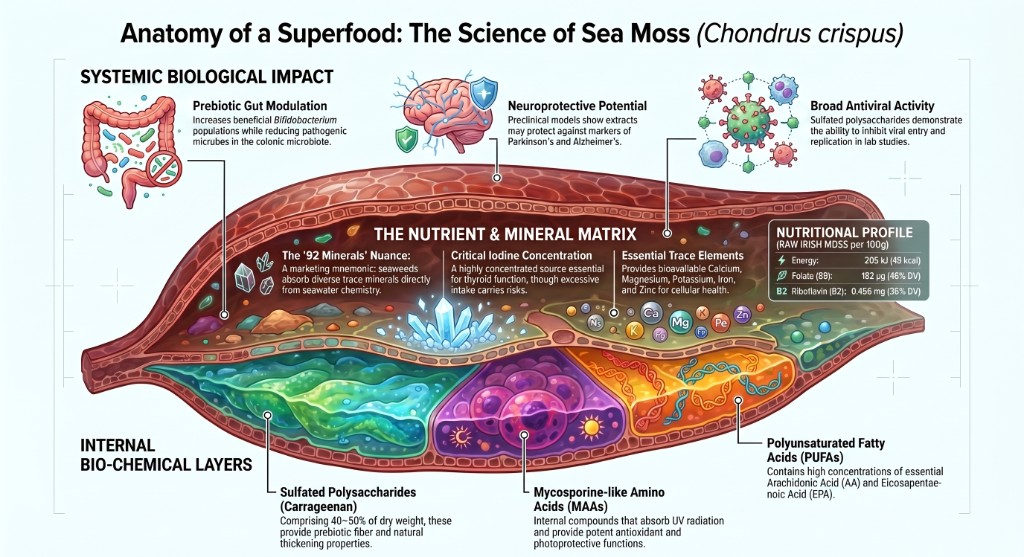
Visual reference
Anatomy of a superfood: what's real in Chondrus crispus
- 92-minerals claim vs. what labs actually measure
- Iodine potency and thyroid safety margin
- Prebiotic carrageenan matrix and trace elements
## The thyroid paradox: iodine toxicity and the Wolff-Chaikoff effect
While *C. crispus* is a potent natural source of iodine an essential trace element serving as a precursor for the synthesis of thyroid hormones (thyroxine and triiodothyronine) it possesses an **exceptionally narrow safety margin**.
Sea moss contains highly concentrated levels of iodine. For context, a typical 45-gram snack of sea moss can yield up to **2.1 mg of iodine** far exceeding the standard safe daily dosage of 4 grams of raw algae recommended by dietary and endocrine experts.
### What happens with excess iodine?
Consuming highly concentrated sea moss supplements can trigger the **Wolff-Chaikoff effect** an auto-regulatory phenomenon wherein the thyroid gland temporarily halts hormone synthesis in response to acute iodine excess to prevent hyperthyroidism.
This creates a dangerous metabolic paradox: the very nutrient supplemented to "boost" thyroid function can effectively act as its **"off switch."**
### Who should exercise caution?
For individuals with pre-existing thyroid pathologies, **medical consultation is non-negotiable** before incorporating sea moss into their diet, as it can severely disrupt hormonal equilibrium.
## Prebiotic efficacy and gut microbiome modulation
Beyond the realm of pseudoscience, legitimate marine research highlights sea moss as a sophisticated **prebiotic matrix** rather than a mere source of bulk fiber.
Studies on model organisms have demonstrated that dietary supplementation with cultivated *C. crispus* effectively modulates the colonic microbiota. Liu et al. (2015) found that *C. crispus* acts as a potent prebiotic, significantly increasing the populations of beneficial bacteria such as *Bifidobacterium breve* while simultaneously reducing the abundance of pathogenic species like *Clostridium septicum*.
Furthermore, the fermentation of the alga's unique digestion-resistant polysaccharides in the gut produces vital **short-chain fatty acids (SCFAs)**, notably butyric, acetic, and propionic acids (Liu et al., 2015). These SCFAs are essential for:
- Maintaining intestinal epithelial integrity
- Regulating local immunity
- Supporting a diverse microbial ecosystem
The high functional fiber content also promotes satiety, aiding in metabolic regulation and weight control. This prebiotic action underscores that sea moss is not merely a dietary trend but a complex structural matrix that supports systemic health via the **gut-immune axis**.
## Neuroprotective potential: combating amyloid-beta toxicity
One of the most compelling frontiers of Blue Biotechnology involves the neuroprotective properties of *C. crispus* extracts.
In neurobiological research utilizing transgenic *Caenorhabditis elegans* models, sea moss extracts have demonstrated the capacity to **suppress paralysis induced by beta-amyloid (Aβ) peptides** primary hallmarks of neurodegenerative decline in conditions like Alzheimer's disease (Sangha et al., 2015).
This protective mechanism is primarily attributed to:
1. **Up-regulation of stress-response genes**
2. **Activation of the SKN-1/Nrf2 signaling pathway** which aggressively mitigates oxidative stress by reducing the accumulation of Reactive Oxygen Species (ROS), thereby offering a buffer against neuro-oxidative damage (Sangha et al., 2015)
While these findings are promising, they remain at the preclinical stage and should not be interpreted as established human therapeutic outcomes.
## Hidden contaminants and the risks of proprietary blends
Despite its biological promise, consumers must exercise extreme caution with commercial products marketed under labels such as **"Cell Food"** or **"Bromide Plus."**
These products frequently utilize "proprietary blend" classifications as a legal shield to obscure unlisted ingredients. Such opacity introduces significant risks, including the potential for triggering severe allergic reactions or dangerous interactions with prescription medications.
### Heavy metal bioaccumulation
Marine macroalgae function as environmental bio-sponges and readily accumulate heavy metals such as **arsenic, lead, and cadmium** from their aquatic surroundings.
Therefore, **transparent sourcing and rigorous third-party analytical testing** are critical, non-negotiable prerequisites for the safe consumption of sea moss products.
## Conclusion: evidence over influencer folklore
The current reality of sea moss is marked by a stark duality:
| Reality | Myth |
| --- | --- |
| Nutrient-dense marine alga with evidence-based prebiotic and neuroprotective potential | Panacea claims of 92 minerals curing disease |
| Complex gut-immune axis support via SCFA production | Alkaline diets altering blood pH |
| Promising SKN-1/Nrf2 antioxidant pathways | Race-based "electrical vibration" nutrition |
| Requires iodine caution and medical oversight | Unlimited daily supplementation without risk |
To truly benefit from *C. crispus*, consumers and practitioners alike must value its genuine biochemical contributions while fundamentally rejecting the mythological hype. A mature, evidence-based wellness journey requires looking beyond influencer-driven marketing to embrace the nuanced, complex biology of the ocean's resources.
## References
- Liu, J., Hafting, J., Critchley, A. T., Banskota, A. H., & Prithiviraj, B. (2015). Prebiotic effects of diet supplemented with the cultivated red seaweed *Chondrus crispus* or with fructo-oligo-saccharide on host immunity, colonic microbiota and gut microbial metabolites. *BMC Complementary and Alternative Medicine*, 15(1), 279. [https://doi.org/10.1186/s12906-015-0802-5](https://doi.org/10.1186/s12906-015-0802-5)
- McGill Office for Science and Society. (2018). "Dr." Sebi: What do we make of this non-doctor? McGill University. [https://www.mcgill.ca/oss/article/quackery/dr-sebi-what-do-we-make-him](https://www.mcgill.ca/oss/article/quackery/dr-sebi-what-do-we-make-him)
- Sangha, J. S., Wally, O., Banskota, A. H., Stefanova, R., Hafting, J. T., Critchley, A. T., & Prithiviraj, B. (2015). A cultivated form of a red seaweed (*Chondrus crispus*), suppresses β-amyloid-induced paralysis in *Caenorhabditis elegans*. *Marine Drugs*, 13(10), 6407 6424. [https://doi.org/10.3390/md13106407](https://doi.org/10.3390/md13106407)
---
*This synthesis was prepared by [SeaMossVibes](https://seamossvibes.com.au), in partnership with the digital architecture experts at [Luminara Digital](https://luminaradigital.io).*
Ready to start?
Turn what you learned into a daily ritual
Explore formats and product details, then check the physical label before use.
Explore products →
Listed ingredients · Storage guidance


