
General information, not medical advice. Sea moss contains iodine. Ask your GP before use if you have a thyroid condition, take medication, or are pregnant or breastfeeding. Quality & Testing.
## Introduction: The deep blue trend
The wellness landscape has witnessed few surges as dramatic as the commercial rise of sea moss. By 2024, the global market for this marine botanical reached an estimated valuation of **$2.18 billion**, propelled by a synergistic mixture of ancestral ethnobotany and contemporary viral media (Henderson, 2026). Yet, as sea moss transitions from a regional traditional remedy to a globally traded commodity, a core scientific curiosity remains: **Is sea moss a legitimate "electric" food that functionally powers the body, or is the wellness community misidentifying the complex biological mechanisms that define its potency?**
Technically classified as a red macroalgae (Rhodophyta), sea moss is far more than a passing dietary trend. It is a nutrient-dense marine organism that exists at the intersection of ethnopharmacology and metabolic bioenergetics. To navigate the commercial noise, the following analysis distills **five critical, academically backed takeaways** that separate clinical reality from social media fiction.
For a broader debunking of viral claims including the 92-minerals myth see [Beyond the Hype: The Surprising Science and Pseudoscience of Sea Moss](/blogs/learn/benefits/sea-moss-science-pseudoscience).
Visual reference
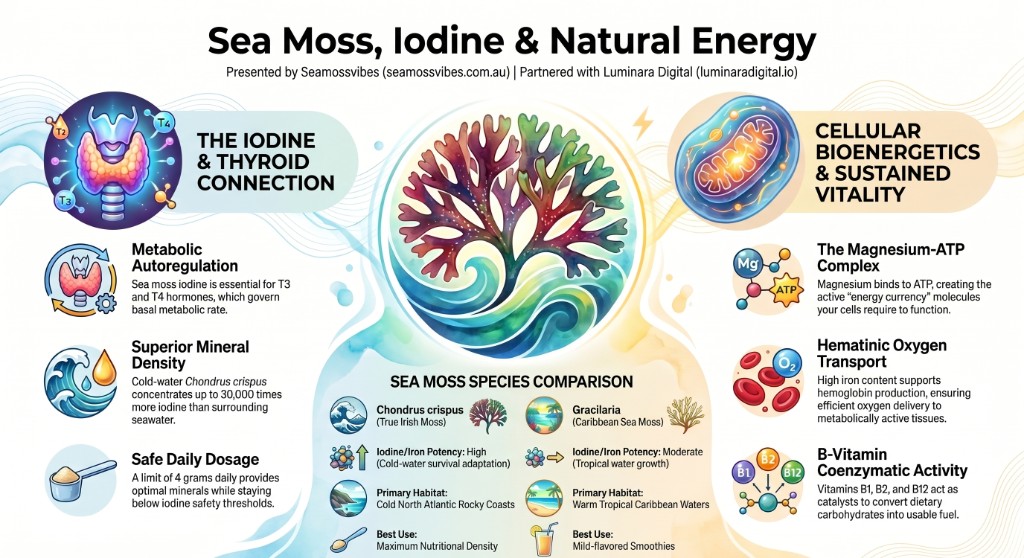
Energy & iodine at a glance
- Mg-ATP, iron, and B-vitamins → sustained vitality
- Iodine → T3/T4, with Wolff-Chaikoff safety margin
- Chondrus crispus vs Gracilaria know what you are buying
## Takeaway 1: The species identity crisis (Chondrus vs. the world)
The term "sea moss" acts as a commercial umbrella for several distinct algal species, making mislabeling a significant consumer risk. The botanical **gold standard** is *Chondrus crispus* (true Irish Moss), an alga that thrives in the cold, turbulent waters of the North Atlantic. To survive these harsh, sub-Arctic climates, the organism has adaptively concentrated a high density of minerals and complex sulfated polysaccharides (Seamossvibes, 2026).
In contrast, tropical varieties such as *Gracilaria* are frequently "pool-grown" or rope-farmed in warmer waters. Beyond the ecological habitat, there is a fundamental biochemical distinction:
| Species | Primary polysaccharide | Typical sourcing |
| --- | --- | --- |
| *Chondrus crispus* | Carrageenan (sulfated galactans) | Wildcrafted North Atlantic |
| *Gracilaria* | Agar (agarose and agaropectin) | Pool-grown or rope-farmed tropics |
This taxonomic difference is crucial. The heavily marketed "electric" nature of sea moss is scientifically attributed to the **strongly negative charge** of these sulfated carrageenan molecules, which facilitate the attraction and binding of proteins, thereby potentially enhancing nutrient bioavailability (Seamossvibes, 2026).
As noted in recent biochemical analyses, wildcrafted *Chondrus crispus* is often heralded as a premium supplement due to its alignment with the African Bio-Mineral Balance theory, which postulates that the alga concentrates a vast majority of the essential minerals required by human physiology in a highly bioavailable, ionic state (Seamossvibes, 2026).
For a deeper mineral breakdown, see [What Minerals Does Sea Moss Actually Contain?](/blogs/learn/benefits/sea-moss-minerals-explained).
## Takeaway 2: Beyond the caffeine crash the science of cellular vitality
Unlike synthetic central nervous system stimulants that trigger a temporary physiological spike, sea moss supports sustainable **natural energy** by providing the direct biochemical substrates required for cellular respiration. It does not artificially force energy; it fuels the cellular machinery.
### The magnesium-ATP complex
Every molecule of adenosine triphosphate (ATP) the primary currency of cellular energy must bind to a magnesium ion to become biologically active. Without this Mg-ATP complex, stored energy cannot be utilized by the body.
### The electron transport chain (ETC)
Sea moss contains vital iron-sulfur clusters and cytochrome complexes. These act as the essential structural infrastructure for the ETC within the mitochondria, facilitating the transfer of electrons required for aerobic respiration (Seamossvibes, 2026; Seatech Bioproducts Corp., 2016).
### The cellular ferryman
Iron functions as the critical cellular ferryman; without sufficient levels, cellular oxygenation is compromised. Sea moss provides elemental iron alongside natural ascorbic acid (Vitamin C), which efficiently reduces dietary iron to its highly soluble ferrous state (Fe²⁺), optimizing hemoglobin synthesis and oxygen transport (Seamossvibes, 2026).
Furthermore, a spectrum of B-complex vitamins (B1, B2, B12) acts as necessary coenzymatic bridges, converting dietary macronutrients into the metabolic fuel our mitochondria burn. This cascade provides **sustained vitality without the subsequent neuro-chemical "crash"** associated with caffeine consumption (Czerwony, 2025).
> **Practical note:** Track energy at day 10, not day 1. Mineral repletion and mitochondrial adaptation take one to two weeks before most people notice a meaningful shift.
Visual reference
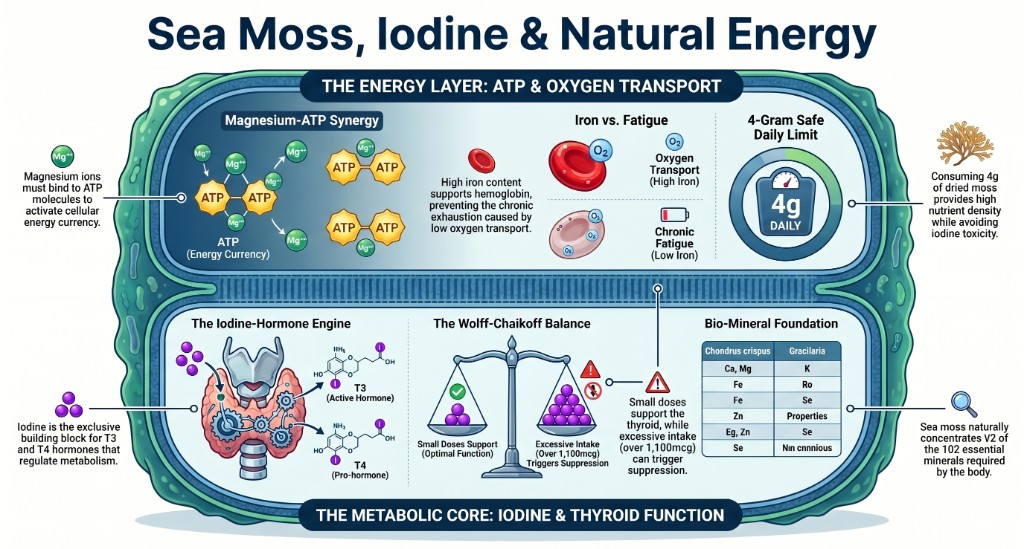
How sea moss fuels cells and where iodine fits
- Magnesium activates ATP; iron carries oxygen
- 4 g dried moss ≈ nutrient density without iodine excess
- Wolff-Chaikoff vs overdose the thyroid balance scale
## Takeaway 3: The iodine biphasic trap (Wolff-Chaikoff vs. Jod-Basedow)
Iodine is arguably the most clinically significant elemental constituent of sea moss, yet it carries a **biphasic biological risk** meaning the body's physiological response changes dramatically based on both the dosage and the individual's baseline thyroid health (Northwestern Medicine, 2026).
The systemic transport of iodine is mediated by the **Sodium-Iodide Symporter (NIS)**, a specialized glycoprotein located in the thyroid, salivary glands, and gastric mucosa (Seamossvibes, 2026).
| Effect | Who it affects | What happens |
| --- | --- | --- |
| **Wolff-Chaikoff** | Healthy individuals | Acute high iodine load temporarily suppresses thyroid hormone synthesis via NIS downregulation |
| **Jod-Basedow** | Graves' disease or autonomous nodules | Body fails to "escape" suppression, triggering iodine-induced hyperthyroidism |
In healthy individuals, an acute, high load of iodine triggers the Wolff-Chaikoff effect a temporary, autoregulatory suppression of thyroid hormone synthesis. This occurs because the body instinctively downregulates the NIS to prevent toxic over-absorption. However, in individuals with latent Graves' disease or autonomous thyroid nodules, the body fails to "escape" this regulatory mechanism, potentially leading to the **Jod-Basedow phenomenon** a state of iodine-induced hyperthyroidism (Rose et al., 2023).
### Clinical precaution
Precision in dosing is vital. Excess iodine is particularly hazardous during the perinatal stage. The fetal thyroid gland is exceptionally sensitive and does not develop the "escape" mechanism required to protect itself from the Wolff-Chaikoff effect until roughly **36 weeks of gestation**. Consequently, unregulated sea moss consumption during pregnancy can induce prolonged fetal thyroid suppression, carrying documented neurodevelopmental risks (Seamossvibes, 2026).
**Thyroid patients must consult practitioners first** before adding sea moss to any regimen. For gut-specific iodine interactions, see [Sea Moss and the Gut](/blogs/learn/benefits/sea-moss-gut-health).
## Takeaway 4: The carrageenan paradox (prebiotic vs. pro-inflammatory)
Sea moss is composed of approximately **55% carrageenan by dry weight**, placing it at the center of a complex nutritional debate. While degraded, refined carrageenan additives (such as E407 used in processed foods) are sometimes linked to gastrointestinal inflammation, the carrageenan found in whole, unrefined sea moss behaves entirely differently due to the **Matrix Effect**.
Whole-food sea moss contains an intact structural matrix composed of cellulose, hemicellulose, and lignin. This robust fiber matrix dictates that the naturally occurring carrageenan acts as a **functional prebiotic** rather than a pro-inflammatory agent. These complex fibers transit to the colon intact, where they selectively stimulate the proliferation of *Akkermansia muciniphila* a keystone commensal bacterium critical for maintaining a thick, protective mucosal barrier in the gut (Seamossvibes, 2026).
By consuming the whole algae rather than chemically isolated extracts, the consumer preserves the structural integrity that actively protects and fortifies the digestive tract (Henderson, 2026).
## Takeaway 5: The arsenic speciation reality check
As a product of an open marine ecosystem, sea moss naturally bioaccumulates heavy metals. However, relying on a **"Total Arsenic" test** is often an academically and clinically unreliable indicator of toxicity. To accurately evaluate safety, analysis must utilize **Arsenic Speciation**.
The vast majority of arsenic found in marine algae exists as **arsenosugars** organic, complexed forms that are rapidly excreted and exhibit remarkably low human toxicity. Ensuring safe consumption requires advanced laboratory testing via High-Performance Liquid Chromatography inductively coupled plasma mass spectrometry (**HPLC-ICP-MS**) to isolate and quantify the highly toxic inorganic arsenic fraction.
### Regulatory thresholds
| Jurisdiction | Limit |
| --- | --- |
| European Union | Inorganic arsenic < 0.1 mg/kg in food |
| California Proposition 65 | Intake < 10 µg/day |
Responsible consumers should demand **batch-specific Certificates of Analysis (COAs)** to verify these biochemical thresholds. For sourcing guidance, see our [Sea Moss Australia Buying Guide](/blogs/learn/resources/sea-moss-australia-buying-guide).
## How to spot fake sea moss: A quick quality guide
To ensure clinical efficacy and mineral density, consumers must avoid common industry red flags associated with adulterated or inferior products:
- **Unnaturally uniform colour:** Authentic *Chondrus crispus* displays natural phenotypic variations (ranging from purple to reddish-brown). A perfectly pale yellow or stark white appearance often indicates harsh chemical bleaching.
- **Lack of species identification:** If a label neglects botanical nomenclature (e.g., distinguishing *Chondrus crispus* from *Gracilaria*), it is highly probable the product is a cheaper, commercially substituted variant (Ocean's Balance, 2026).
- **"Pool-grown" sourcing:** While often deceptively marketed as "cleaner," pool-grown moss is entirely deprived of the turbulent, mineral-dense benthic environment of the open ocean.
- **Suspicious textures:** Sea moss gels that are unnaturally viscous may contain synthetic thickeners or added gums, rather than pure algae and alkaline water.
- **No refrigeration required:** Authentic sea moss gel is a highly perishable, bioactive food. If it remains shelf-stable at room temperature without preservatives, it is not a pure botanical product.
### Practical safety tip
Always discard the initial soaking water. Vigorously scrubbing and thoroughly rinsing raw moss can significantly diminish surface-level contaminants and superficial heavy metal loads prior to culinary preparation (Seamossvibes, 2026).
For gel preparation and dosing, see our [Gel Dosage Guide](/blogs/learn/how-to-use/gel-dosage-guide).
## Conclusion: A thoughtful path to marine wellness
Sea moss is a sophisticated functional food, not a panacea. Its true biological power lies in its capacity to functionally support mitochondrial respiration and systemically remineralize the body through a highly unique marine matrix. However, its explosive commercial popularity necessitates an urgent shift within the supplement industry toward rigorous DNA species verification and highly transparent, speciation-based contaminant testing.
As modern wellness turns its gaze toward the ocean for vitality, our responsibility is to remain firmly anchored in evidence-based science, viewing genuine sea moss as a valuable, biologically active partner in a balanced, nutrient-dense lifestyle.
| What sea moss may support | When caution is required |
| --- | --- |
| Sustained cellular energy via mineral cofactors | Thyroid disease or iodine excess |
| Verified *Chondrus crispus* with batch COAs | Unlabelled species or pool-grown substitutes |
| Whole-food prebiotic carrageenan matrix | Pregnancy without practitioner clearance |
| Speciation-verified low inorganic arsenic | Products with no heavy-metal testing |
## References
- Czerwony, B. (2025). 8 sea moss benefits. *Cleveland Clinic Health Essentials*.
- Henderson, T. (2026). Complete guide to sea moss testing and analysis. *Contract Laboratory*.
- Northwestern Medicine. (2026). Health benefits and risks of sea moss: What you should know. *HealthBeat*.
- Ocean's Balance. (2026). Irish moss vs. sea moss: Understanding the differences.
- Rose, H. R., Zulfiqar, H., & Anastasopoulou, C. (2023). Jod-Basedow syndrome. *StatPearls Publishing*.
- Seamossvibes. (2026). Clinical and biochemical analysis of Rhodophyta: Endocrine modulation, metabolic bioenergetics, and systemic toxicology of sea moss.
- Seatech Bioproducts Corp. (2016). Nutritional content of *Chondrus crispus* (Irish moss).
- Team Erbology. (2025). Irish moss vs sea moss: What's the difference? *Erbology Editorial*.
---
*This synthesis was prepared by [SeaMossVibes](https://seamossvibes.com.au), in partnership with the digital architecture experts at [Luminara Digital](https://luminaradigital.io).*
Ready to start?
Turn what you learned into a daily ritual
Explore formats and product details, then check the physical label before use.
Explore products →
Listed ingredients · Storage guidance


