General information, not medical advice. Sea moss contains iodine. Ask your GP before use if you have a thyroid condition, take medication, or are pregnant or breastfeeding. Quality & Testing.
## Introduction: From famine food to a $2 billion market
Sea moss, historically categorized as a humble "poverty food" used for survival during the Irish Potato Famine of the 1840s, has undergone a radical commercial transformation. Coastal populations originally boiled *Chondrus crispus*, the true Irish moss, to extract gelatinous carbohydrates, providing essential calories when land-based crops failed.
In the modern wellness landscape, sea moss has emerged as a global phenomenon. Driven by social media and celebrity endorsements, the global sea moss market was valued at approximately $2.18 billion in 2024 and is projected to reach $2.60 billion by 2030 (Henderson, 2026). This shift from a survival staple to a luxury wellness asset necessitates a rigorous examination of its biochemical reality, balancing historical folklore with analytical chemistry.
## The 92-mineral myth: Deconstructing the "cell food" narrative
The most pervasive marketing claim within the wellness industry states that sea moss contains "92 of the 102 minerals the body needs." This narrative, popularized by alternative health frameworks such as those by Alfredo Bowman (Dr. Sebi), collapses under clinical and biochemical scrutiny.
An honest breakdown of sea moss requires moving away from arbitrary element counting and focusing instead on verifiable, bioavailable nutrients:
```
[ Total Elements in Earth's Crust / Oceans: ~92 102 ]
│
┌──────────────────┴──────────────────┐
▼ ▼
[ Biologically Essential Elements ] [ Biologically Inert / Toxic Fractions ]
(Requires 20 29 elements total) (Lead, Cadmium, Uranium, Arsenic)
```
### What the human body actually needs
From a clinical biochemistry perspective, the human body only requires between 20 and 29 essential elements to support metabolic processes and structural integrity:
- **Macronutrients:** Eleven elements (including carbon, oxygen, hydrogen, calcium, and sulfur) comprise 99.85% of human body weight.
- **Ultratrace elements:** Approximately 18 elements account for the remaining fraction.
The "92 minerals" figure conflates the total number of naturally occurring elements found in the earth's crust and oceans with human nutritional requirements. Marine organisms non-selectively accumulate trace elements from surrounding seawater. Consequently, this background accumulation includes elements that are biologically inert or highly toxic to human physiology: such as lead, uranium, and cadmium: rather than representing beneficial "cellular nourishment."
### What labs actually confirm
Instead of chasing an unverified elemental count, empirical data confirms that sea moss contains meaningful, measurable levels of a specific subset of essential minerals, including **iodine, magnesium, potassium, iron, and zinc**. These are the nutrients most relevant to everyday wellness goals, not an arbitrary tally of every element in seawater.
## The species identity crisis: Not all "sea moss" is created equal
The commercial term "sea moss" functions as an umbrella designation that frequently obscures widespread species mislabeling within the supply chain. While the traditional standard for authenticity is the cold-water rhodophyte *Chondrus crispus* found in the North Atlantic, the vast majority of products sold in consumer markets are actually tropical species belonging to the *Gracilaria* or *Eucheuma* genera (Henderson, 2026).
These species are taxonomically and chemically distinct, yielding different structural polysaccharides and mineral profiles:
| Feature / compound | True Irish moss (*Chondrus crispus*) | Tropical sea moss (*Eucheuma cottonii* / *Gracilaria*) |
| --- | --- | --- |
| Native habitat | Cold-water North Atlantic | Warm, tropical waters (e.g. Caribbean, Pacific) |
| Primary polysaccharide | Rich in lambda-carrageenan | *Eucheuma*: kappa-carrageenan; *Gracilaria*: agar |
| Commercial sourcing | Wild-harvested rock populations | Frequently farm-raised or ocean-cultivated |
> "Most commercial sea moss sold in the United States today, especially gold, purple, and Jamaican varieties, is actually *Gracilaria* species from the Caribbean. These species have different chemical compositions and different mineral profiles."
> Henderson, T. (2026). *Complete Guide to Sea Moss Testing and Analysis.*
To combat quality degradation, transparent suppliers emphasize verifiable geographic origins. At SeaMossVibes, we small-batch process wild-harvested moss from regions like Saint Lucia, explicitly screening out pool-grown variants and synthetic fillers to preserve natural elemental integrity.
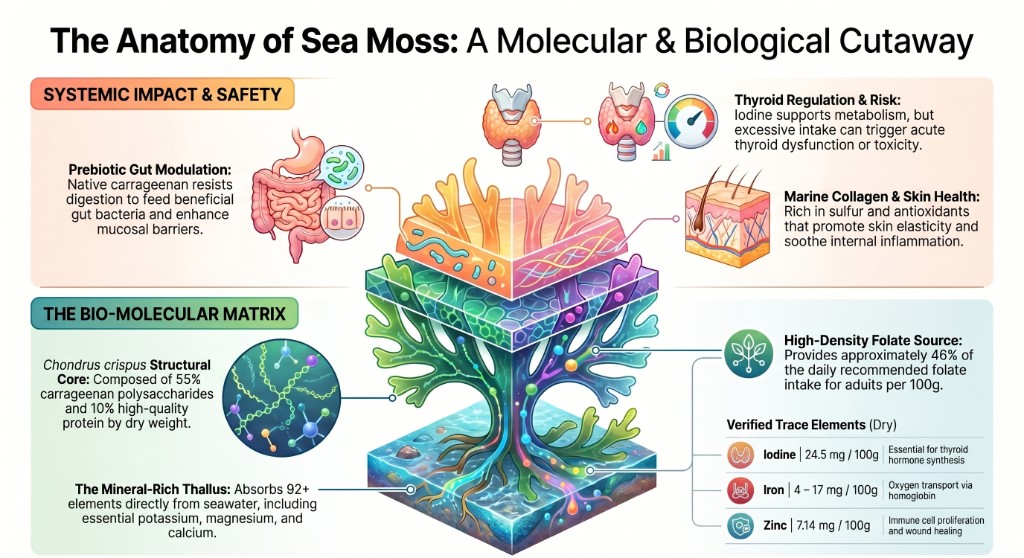
Visual reference
Explore the molecular cutaway
- Gut prebiotic matrix and thyroid iodine dynamics
- Verified iodine, iron, and zinc per dry-weight lab ranges
## The iodine paradox: Nutrient vs. toxicant dynamics
Iodine is the most biochemically potent element within sea moss, serving as the required substrate for the synthesis of thyroid hormones thyroxine (T₄) and triiodothyronine (T₃). However, due to variable environmental bioaccumulation, the iodine concentration in sea moss can reach toxic thresholds.
The tolerable upper intake level (UL) for iodine in healthy adults is established at **1,100 μg per day**. Analytical testing demonstrates that a single 45-gram serving of dried *Chondrus crispus* can deliver up to **2,100 μg of iodine**: nearly double the safe daily limit (Henderson, 2026).
This high concentration presents a steep nutrient-toxicant trade-off. For example, a 100 g serving of sea moss provides 182 μg of folate (46% of the adult Recommended Dietary Allowance), yet the concurrent iodine exposure in that same portion can be hazardous. Excess dietary iodine can precipitate severe thyroid autoregulatory dysfunctions:
### The Wolff-Chaikoff effect
A rapid acute influx of inorganic iodine transiently suppresses thyroid peroxidase organification, which can induce hypothyroidism and goiter formation (Smyth, 2021).
### The Jod-Basedow phenomenon
In individuals with underlying thyroid nodules or latent Graves' disease, an iodine overload escapes normal down-regulation, triggering autonomous, accelerated thyroid hormone synthesis and inducing acute thyrotoxicosis.
Because of this profound environmental volatility, **batch-specific quantification via Inductively Coupled Plasma Mass Spectrometry (ICP-MS)** is a vital consumer safety requirement rather than an optional manufacturing luxury.
## Polysaccharides, gut health, and the taurine factor
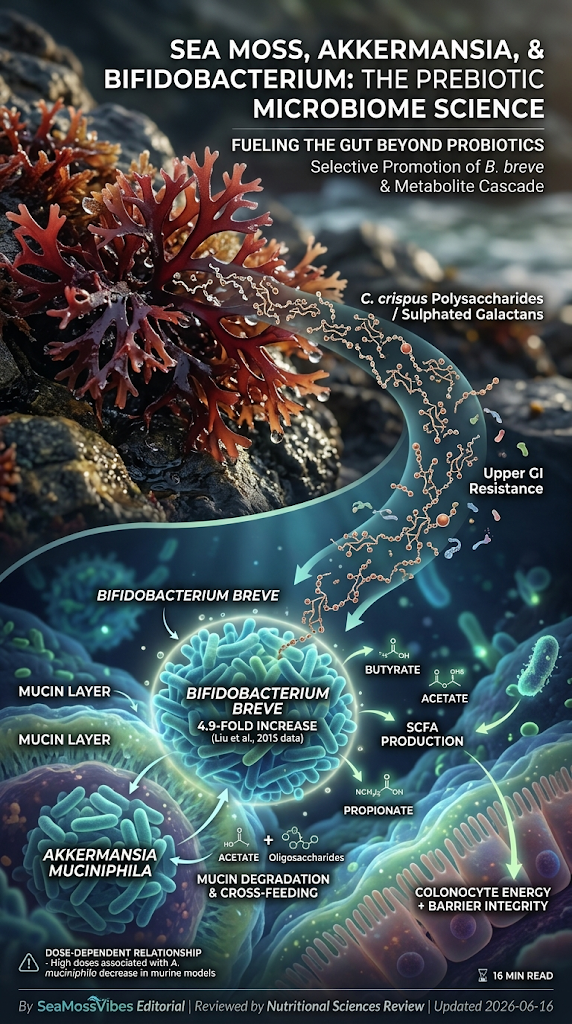
Sulfated polysaccharides comprise approximately 55% of the dry weight of *Chondrus crispus*. Public health discussions often conflate "native" seaweed carrageenan with "degraded" carrageenan (poligeenan).
### Native carrageenan
This high-molecular-weight carbohydrate (>100 kDa) resists gastric acid hydrolysis and enzymatic digestion in the upper gastrointestinal tract. It acts as a prebiotic substrate, selectively promoting the proliferation of beneficial *Bifidobacterium* and *Lactobacillus* species. These gut benefits align with the mucilage properties of carrageenan, which physically coats the gastrointestinal lining and hydrates localized tissues.
### Poligeenan (degraded carrageenan)
This low-molecular-weight variant is produced via deliberate, high-temperature industrial acid hydrolysis. It is clinically associated with intestinal inflammation and mucosal ulceration in animal models, but it does **not** occur naturally in properly prepared sea moss gels (Henderson, 2026).
### Taurine: A marine-derived amino acid
Beyond structural carbohydrates, sea moss contains the sulfur-containing amino acid **taurine** (Herbal Reality, 2024). Taurine plays crucial roles in cardiovascular function, bile acid conjugation, and cellular osmoregulation. Because taurine is virtually absent from terrestrial plants, standardized sea moss preparations offer a unique, marine-derived nutritional source for vegan and vegetarian populations, provided the baseline iodine risks are managed.
## Fertility and folklore: Animal models vs. human data
In Jamaican folk medicine, sea moss has long been used as an aphrodisiac and fertility aid, traditionally termed "Nature's Viagra." Nutritional profiling provides indirect support for these claims, as sea moss contains trace amounts of zinc (1.95 mg/100 g), an essential cofactor for testosterone synthesis, spermatogenesis, and immune function (Heath, 2025).
However, direct human clinical evidence validating these reproductive benefits is non-existent. A 2021 in vivo study published in the *Saudi Journal of Biological Sciences* demonstrated that *Chondrus crispus* supplementation enhanced testicular weight and spermatogenic markers in male albino rats, but these outcomes have not been replicated in human clinical trials (Heath, 2025).
> "While sea moss contains nutrients that are beneficial for fertility, there is currently no scientific research specifically linking sea moss consumption to improved fertility outcomes in humans."
> Heath, I. (2025). *Does Sea Moss Help with Fertility?* Primal Harvest.
## Arsenic speciation and heavy metal bioaccumulation
As an open-system marine bioindicator, sea moss effectively absorbs heavy metals from coastal agricultural and industrial runoff. While "total arsenic" concentrations in raw sea moss metrics frequently appear alarmingly elevated (ranging from 10 to 50 mg/kg), consumer safety depends entirely on **arsenic speciation** (Henderson, 2026):
```
[ Total Arsenic Accumulation (10 50 mg/kg) ]
│
┌─────────────────────────┴─────────────────────────┐
▼ ▼
[ Organic Arsenosugars ] [ Inorganic Arsenic ]
- Complex marine matrix - Highly toxic / carcinogenic
- Relatively benign to humans - Regulated strictly (<10 μg/day)
```
The majority of arsenic bound within rhodophytes exists as **organic arsenosugars**, which exhibit low acute toxicity and are largely excreted by the human renal system without undergoing substantial cellular degradation (Henderson, 2026). The primary clinical risk stems from the **inorganic arsenic** fraction, a potent carcinogen and toxicant. Regulatory guidelines, such as California Proposition 65, enforce a strict maximum allowable dose level of 10 μg per day for inorganic arsenic.
Consequently, basic elemental analysis is insufficient for verifying safety. Analytical laboratories must utilize **High-Performance Liquid Chromatography coupled with Inductively Coupled Plasma Mass Spectrometry (HPLC-ICP-MS)** to separate and accurately quantify the toxic inorganic fraction from the benign organic matrix.
## Conclusion: The analytical takeaway
Sea moss is a complex marine nutraceutical rather than a simple, predictable multivitamin alternative. While it offers distinct biochemical benefits, including prebiotic carrageenans, trace elements, and essential amino acids, it lacks the elemental standardization required for uniform, daily supplementation without professional oversight.
For consumers looking to integrate sea moss into their health routines, clinical caution is advised. Whole-food gel matrices can offer superior absorption context compared to isolated mineral pills, but they must be introduced deliberately. Individuals utilizing sea moss for metabolic or thyroid support should undergo comprehensive baseline diagnostics, specifically a serum thyroid panel evaluating Thyroid-Stimulating Hormone (TSH), free T₃, and free T₄, to protect against iodine-induced thyroid dysfunction.
The transition of sea moss from internet hype to a reliable dietary resource relies on analytical chemistry to guarantee safety, verification, and clinical efficacy.
## Next step
[Take the Mineral Blueprint](/vitality/assessment) to see whether gel or capsules match your primary goal, and get a personalised 14-day protocol built around verified nutrients, not marketing counts.
## References
- Biochemical Characterization of *Chondrus crispus*: Analyzing the Actual Mineralogical Composition, the "92 Minerals" Claim, and Clinical Implications. (n.d.).
- *Chondrus crispus* Wikipedia. (n.d.).
- Heath, I. (2025, December 7). Does Sea Moss Help with Fertility? *Primal Harvest*.
- Henderson, T. (2026, April 13). Complete Guide to Sea Moss Testing and Analysis. *Contract Laboratory*.
- Irish Moss (*Chondrus crispus*): Benefits, Uses, Safety. (2024, August 14). *Herbal Reality*.
- SeaMossVibes Wellness Team. (2026, June 1). What Minerals Does Sea Moss Actually Contain? *Nutritional Sciences Review*.
- Smyth, P. P. A. (2021). Iodine, Seaweed, and the Thyroid. *European Thyroid Journal*, 10(2), 101 108.
Ready to start?
Turn what you learned into a daily ritual
Explore formats and product details, then check the physical label before use.
Explore products →
Listed ingredients · Storage guidance